

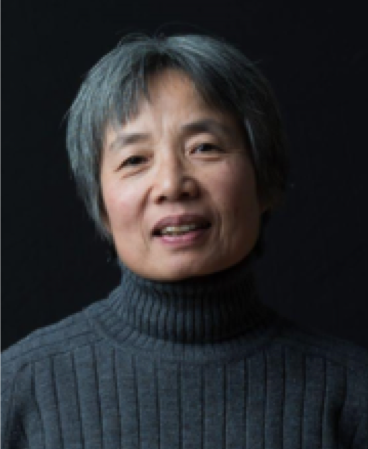
A Love of Learning and Helping Others Succeed: Wendy Guan, CGA Executive Director, Retires

There’s a map on the wall of Wendy Guan’s office covered in red. There are so many rosy dots that the image beneath them isn’t immediately identifiable. On second glance, the slim outline of Italy, its Mediterranean island of Sicily, and the tip of Tunisia come into focus.
The vibrant points on the map, Guan explained, enabled Harvard’s Francis Goelet Professor of Medieval History Michael McCormick to connect the dots, so to speak. He had once turned to Guan and her team at Harvard’s Institute for Quantitative Social Science’s (IQSS) Center for Geographic Analysis (CGA) to help him track the path of a deadly outbreak known as the Plague of Justinian from 541–ca. 750 CE for his medieval history class.
“I was overjoyed when hearing him presenting his findings with our mapping tools, illustrating how occurrence of the plague seemed to coincide with popular land and sea trade routes at the time, and suggesting merchants were carrying the deadly disease across ancient Roman roads as they traveled,” said Guan.

The map is just one example of the work Guan has supported as the executive director of CGA for almost 20 years. During her tenure she has helped scholars, students and experts from various departments across Harvard and beyond use state-of-the-art geospatial analysis software and rich datasets to better understand the world and to address some of its most pressing problems. Guan retires at the end of February 2025, knowing her two decades of work have helped myriad projects and countless scholars.
“To see something come out of our work was always so rewarding,” said Guan. “Watching somebody take our data and turn out an amazing discovery, something we wouldn't have the bandwidth to do ourselves, was just such a joy. Our strength is really being able to build databases and then coordinate the application of these data to help others do their research more effectively. Through our work we’ve also been able to facilitate critical connections within Harvard and with outside institutions.”
Critical indeed. Some of those connections have helped save lives. By harvesting a range of data in collaboration with Boston University, Guan and her team provided detailed structural maps that aided first responders during their search for victims of a 7.3 earthquake in Haiti in 2010, and they offered up information for officials following the 2011 earthquake and Tsunami in Fukushima, Japan that triggered a nuclear meltdown. They have helped track the spread of COVID, assisted students harvesting social media tweets tied to the Arab Spring, and aided scholars exploring climate change-driven migration from Africa to Europe by examining site specific environmental and economic factors, conflicts, and government policies and tracking people’s movement across continents using cell phone data.
Other work supported by CGA has shined a light on history or the humanities, such as McCormick’s map. Another project Guan recalls fondly involved tracing fluctuations in religious practices in a South American country by charting the spikes in the rentals of certain religious themed outfits for Catholic and Protestant holidays. Rachel McCleary, the Harvard researcher in charge of the data, had thousands of records from a range of stores that rented the attire, said Guan. Using CGA’s tools she was able to see the shifting popularity of the costumes corresponding to one religion or the other over a 30-year period, plotting it out on a digital screen.
“The map was flashing, dancing back and forth,” remembers Guan with a smile. “Studying religion. I would never have dreamed of doing that before I came here to Harvard.”
Breaking new ground
The CGA was created in 2006, to support research and teaching across all University disciplines as they relate to geospatial technology and methods. The center combines consultation services, technical training, platform development, and sponsored research, and supports a perse range of projects involving geospatial analysis.

at DataHop 2024
"Wendy helped build our Center for Geographic Analysis, which provides support services to faculty all across the University’s departments and schools, and has inspired other universities to build similar GIS groups,” said IQSS director and Albert J. Weatherhead III University Professor Gary King. “She built CGA into a powerhouse and made a big difference here, as well as nationally and even internationally.
King called Guan “utterly reliable, completely unflappable, impossible to provoke. She is exactly the kind of person you would want to lead a major institution. Wendy makes contributions as an individual, but her contribution to the institution is her focus and is extraordinary.”
Often that contribution was made behind the scenes. King said Guan preferred to keep a low profile, giving visibility to others and empowering them to do their work. “We all sometimes learned about the range of projects she was involved in when the results were in, or sometimes even through the news media,” he said, more than once reading a story about an interesting project only to find it had been generated at IQSS through CGA.
“She made it possible for everybody to discover, preserve and distribute knowledge in better ways than they could otherwise, by building on geographic data and perspectives in particular,” said King, adding, “when a student came to me with a question that was related to what she was doing, I'd just say, ‘take the elevator down to CGA. Find Wendy.’”
A life on the move
It seems only fitting that Guan would gravitate towards a discipline involving geography. Most of her life has been defined by a range of significant moves – some planned, others entirely out of her control.
Guan was born in China in 1961, to academics who taught literature at Beijing University. Only a handful of years later they were leaving everything they knew behind in China’s Cultural Revolution – as academics, her mother and father were considered “members of the bourgeoisie threatening to seize political power from the proletariat,” according to a government decree issued by Mao Zedong’s officials in 1966 that urged all citizens to root out such threats. Her parents were fired from their jobs and exiled to the countryside where hard labor in the fields, Mao insisted, would serve as their reeducation.

From those early days, just before they were sent away, one memory in particular stands out for Guan, of watching the Red Guards raid her childhood home and burn her family’s books in the courtyard. Only allowed to access one room in their house to retrieve personal items, Guan protested, eager to enter another to recover her favorite stuffed toy. Her parents, she recalls, warned her to “not to even think about trying to open that door.”
Following a 1,200-mile trek from the country’s capital by boat, rail, bus, and donkey to her parents’ ancestral home not far from Hong Kong, the family became rice farmers, plowing the fields with oxen as their only help. In the ensuing years, Guan was able to spend a brief period of time in Beijing as a teen thanks to savings her mother was able to retrieve from their state-frozen assets. The trip left its mark.
“I could see the transition, the difference in the geography and the way people lived,” said Guan, “and I was so intrigued by that.”
As the child of two professors, Guan learned early that academics and rigorous study were prized at home. She became an avid reader and learned to speak English thanks to the radio her parents had spent all their savings to purchase. It brought her the Voice of America (VOA). The penalty for listening to such an “enemy’s radio station” “was prison or worse; Guan witnessed teachers in a nearby town being sentenced to decades behind bars when someone caught them listening to VOA.
“Every year people were pulled out of their homes, rounded up and sent to prison, or shot.”
It was a dark time, but Guan found light in learning. When Mao died in 1977, Guan’s hope grew as China gradually opened its doors to the wider world. After taking college entrance exams, she became one of only 50 students out of tens of thousands from her county to attend University. But the country, still deeply secretive and wary of outside influence, rendered the study of maps, geographic imagery, and aerial photos – Guan’s true passion – impossible for her. Instead, she majored in biology at South China Normal University in Guangzhou and applied to an ecology program for her graduate studies in Beijing within Peking University’s geography department. Unsurprisingly, she “sat in on a lot of geography classes.” After receiving her master’s degree Guan took a position at Tsinghua University’s new urban planning institute in Beijing. She split her time between teaching urban ecology classes and doing research. But she longed to travel beyond China’s borders.
“I envied those classmates who had relatives they were able to visit in the United States or Europe or those lucky enough to get chosen by their employer to get sent to work overseas.” But the timing was right – in 1984 the country had begun easing certain travel restrictions, and two years later Guan pounced. “I didn’t care where I went or what I studied. I was going to squeeze through the crack in the door for fear that it would shut again.”
A new life in a new country from coast to coast
Guan landed first in Ontario, Canada for her second master’s degree in Canadian heritage and development studies at Trent University, and eventually moved to Georgia to pursue a PhD in ecology at the University of Georgia’s Institute of Ecology led by Eugene Odum, who was widely recognized as the “the Father of Modern Ecology .” Her plan was to finish her doctorate and move back to China. Then she began hearing about protestors gunned down in the streets. Her voice breaks as Gaun recalls the friends she lost and the hopes she had for her country.
“The Tiananmen massacre changed everything. I was happily indulging in my ecology, thinking that I was going to bring the most modern urban ecological theories back to China, because it was getting better… until 1989.”
Guan pivoted again from environmental and ecological system modeling to geographic information systems (GIS), after realizing she “needed to get a job in the US because I wasn’t going back, and GIS was a booming field.” She completed her postdoctoral work at the State University of New York at Buffalo then moved south to work for the South Florida Water Management District as a geographer leading the GIS team. She married and had two children. She also acquired more database management, system design, and programming skills, and set aside her dream of returning to academia.
Her next job required a move across the country to work with a Seattle-based multinational corporation involved in forestry and conservation. The position was a good fit, but Guan struggled to adapt to the office environment. She was often the only female, nonwhite person under the age of 50 in the room. “I was used to being the foreigner,” said Guan, “but there were cultural subtleties that I was not able to pick up in terms of relationships and internal politics.” When the company reorganized, she was squeezed out.
She began working for a GIS consulting firm and was planning to move back to Florida with her family when a certain email caught her eye. “It was a listing for a job in Cambridge, miles away from Florida,” said Guan. “But I thought it’s Harvard, I have to take a look.” When she read the description she realized it was her “dream job.”
For CGA founding director and hiring manager Peter Bol, Guan was a dream candidate.
“Wendy came in as somebody who had good experience at GIS. She had worked both in industry to that point but had a Ph.D. in the field,” said Bol, Harvard’s Charles H. Carswell Professor of East Asian Languages and Civilizations. “And she was very, very thorough, very hard-working, and very fair.”

Guan immediately got to work on Bol’s three priorities: supporting faculty and student research using spatial analysis; setting up training to enable more people to acquire the skills necessary to use the center’s software and geospatial methods; and making connections to faculty across the university.
“Wendy saw what we needed to do,” said Bol, “and started to figure out ways to do it.”
The thing Sumeeta Srinivasan remembers most about working with Guan is her kindness. In 2006, Srinivasan was taking care of two young children as husband traveled in India. Trying to juggle work and childcare, she got the time wrong for her interview with Guan for a CGA preceptor position.
“Wendy was very kind and rescheduled and I just remember that kindness,” said Srinivasan. “She was someone who really understood what I was going through.”
Guan was also there for Srinivasan during a health scare.
“I had very early stage breast cancer during my tenure. Wendy held my hand through it because I think she was the only one I told. That personal touch is something I really admire and won’t forget.”
Currently a professor at Tufts University, Srinivasan used Guan as a reference when applying for the role. “In part I owe the job that I currently have at Tufts to some of the kinds of things that Wendy said about me.”
Lifting others up both personally and professionally seems to come naturally for Guan and has been a hallmark of her Harvard time.
In April of 2020, when a group of students wanted to volunteer to do geographic analysis and mapmaking to help with the response to COVID-19, Guan didn’t hesitate to set them up with the right software and tutor them in the methodology. The extra work was all on her own time, said Jeff Blossom, GIS services manager at CGA. By March of 2021 the group, known as the Coronavirus Visualization Team, had more than 600 members working on dozens of projects.
“It’s a great showcase of her desire to use geospatial science to make things better and then realizing her role as a mentor and an educator to get hundreds of students excited and on the right track to do valid research to aid the understanding and recovery from COVID,” said Blossom, who has worked under Guan since 2007. He called her a “dream” manager.
“No problem was too big for her, and she really had the CGA at her heart and just really wanted to enable her staff to excel,” said Blossom. “Even in these last few months, she's been doing everything possible to make it as smooth as possible for us and her replacement to keep us moving. She really is a lead-by-example person.”
Learning, looking back and next steps
Guan laughs when she recalls how her work with technology has evolved through the years. She thinks back on the machine she used at Tsinghua University – a cumbersome piece of equipment connected to a mechanical arm that would manually place points on a map to mark out industrial, residential, or park space. Today she often works on a sleek laptop using some of the most complex mapping and data software available. And her love for learning never faded; her colleagues routinely cite her ongoing desire to be up on the latest innovations in the geospatial sector and beyond.
“She was constantly learning,” said Bol. “I remember stopping by her office at various points and finding her repeatedly on webinars so she could keep abreast of new things happening in the field.”
“Wendy knows so much about technology in general,” said Blossom, “and keeps on top of everything, geospatial or otherwise.”
Looking back at her long career Guan said she “went from biology to ecology to geography, to environmental modeling, and from being a power user of the technology and a practitioner, to an enabler.” She also calls the Harvard professors she’s worked with “enablers,” because they “not only use the technology,” said Guan, “they also enhance the tools.”
She also considers her colleagues and the professors, scholars, and students she’s worked with deep sources of inspiration.
“They are all so passionate about what they do. You feel the energy and passion from them, and you can’t not be excited by it. Every morning I would get up and look forward to coming to work. I had no concept of using GIS to study public health, humanities, history, social justice, business – all that was brand new to me,” said Guan. “I’ve learned so much from my colleagues and I’ve loved it.”
Next up for the mother of two is another kind of love, and another relocation. After she retires she will be spending her time on the West Coast with her daughter in the Bay Area, helping to take care of her new grandson.
“That’s my next dream job,” said Guan.
Do you have news to share?
We're always interested in hearing the latest work and accomplishments from IQSS affiliates and would be happy to help you share your news. If you have any updates, let us know!


